
















This section contains a summary of some of the key trials published in peer-reviewed medical journals, and begins with a summary of the International EECP Patient Registry of over 5000 patients, which provides data demonstrating therapeutic outcomes and duration of benefit, and the CCS functional class system.
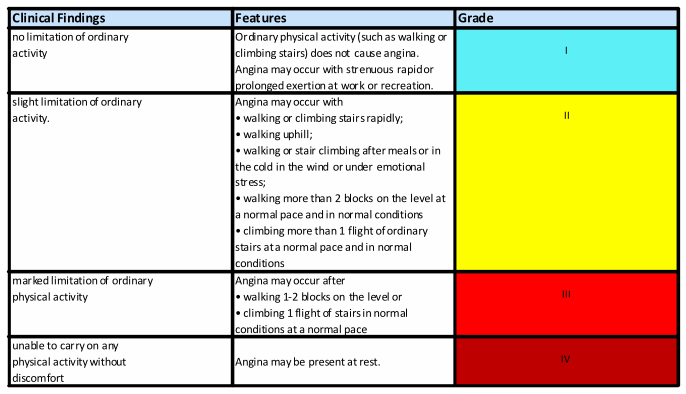
The Canadian Cardiovascular Society Functional Classification of Angina
The table below outlines a scoring system to grade the severity of symptoms suffered by people with angina. If you have angina you may wish to look at the table below to grade your symptoms of angina against the classes I (mild) to IV (severe).
Data gathered by International EECP Patient Registry of over 5,000 patients (see IEPR study below) showed:
- after 24 months follow up 31% of patients recorded being angina free compared to 0% at the start of the study.
- 82% of patients improved after EECP by one or more CCS class
- 43.9% of patients improved after EECP by two or more CCS classes
- Benefits were sustained over the 24 month follow up, the table below summarises the data:
The International EECP Patient Registry (IEPR) provides data demonstrating therapeutic outcomes and duration of benefit
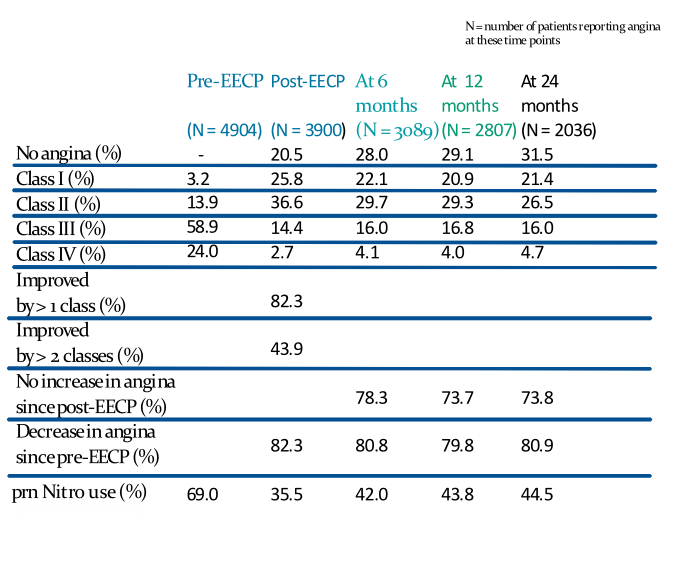
Summary of The International EECP Patient Registry (IEPR)
- In January 1 998, Phase 1 of the IEPR was established to document patient characteristics, safety, efficacy, and the long-term outcomes of EECP therapy for patients treated in the clinical practice setting. The IEPR is a voluntary registry enrolling consecutive angina patients, open to all EECP providers. At the close of Phase 1 in July 2001 more than 5,000 patients had been enrolled.
- The treatment outcomes (decrease in anginal symptoms and nitroglycerine usage, improvement in quality of life) reported by the IEPR confirm those seen in the MUST-EECP trial, as well as results seen in other studies. Analysis of long-term outcomes demonstrates that the clinical benefits achieved with EECP therapy are sustained up to at least 24 months following an initial course of treatment.1
- IEPR Phase 2, initiated in January 2002 with a 2,500patient enrollment goal, augments the chronic stable angina patient data of Phase 1 with the addition of heart failure-specific data points. The IEPR has provided data for abstract presentations at all major cardiology meetings held worldwide in addition to providing data for publications in the major peer-reviewed cardiology journals. Information about the IEPR and the complete IEPR bibliography can be found at: www.edc.gsph.pitt.edu/iepr
MUST-EECP
- Arora, et al,6 Columbia-Presbyterian Medical Center, New York, NY
- The MUST-EECP trial was a randomised, controlled, double-blinded study carried out at seven leading university hospitals in the United States. The study evaluated the effect of EECP therapy testing the reproducibility of benefits observed in earlier studies.
- Patients were randomised to active (full EECP treatment pressure) or sham (minimal EECP pressure) treatment groups.
- Patients in the active EECP therapy group demonstrated a statistically significant increase in time to exercise-induced ST segment depression when compared to sham and baseline, and reported a statistically significant decrease in the frequency of angina episodes when compared to sham and baseline
- Exercise duration increased significantly in both groups; however, the increase was greater in the active EECP group.
- Multicenter Study of Enhanced External Counterpulsation (MUST-EECP: Effect of EECP on Exercise-Induced Myocardial Ischaemia and Anginal Episodes. The Journal of the American College of Cardiology, 33(7), 1833-1840
Congestive Heart Failure Feasibility Study
- This multicenter feasibility study demonstrated that with judicious patient selection, careful application, and monitoring, EECP therapy was well-tolerated in euvolemic, stable heart failure patients. EECP therapy appears safe when applied as an adjunct therapy in this patient population. Efficacy data suggest that EECP therapy may improve exercise capacity and functional status, and enhance quality of life in the short-term and for six months after completion of a course of therapy.
- The results of this feasibility study supported findings of reports from the IEPR on angina patients with LVD or a history of heart failure,7,10 and prompted initiation of the PEECH trial.
- Soran, et al, 7 University of Pittsburgh, PA
THE PEECH TRIAL
The Prospective Evaluation of EECP in Congestive Heart Failure (PEECH) trial evaluated the efficacy of EECP therapy for the treatment of congestive heart failure. The results demonstrated that EECP therapy was significantly more effective in improving exercise duration than optimal pharmacologic therapy alone.
After six months, exercise time increased in the EECP group and decreased in the control group. Additional endpoints of
symptom status, assessed by New York Heart Association (NYHA) functional class, improved 31% in the EECP group compared to 16% in the control group. Overall quality of life also improved significantly among patients treated with EECP therapy.
CENTRAL HAEMODYNAMICS
In this cath lab study Michaels, et al demonstrated that: "EECP unequivocally and significantly increases diastolic and mean pressures and reduces systolic pressure in the central aorta and coronary artery. Coronary artery flow, determined by both Doppler and angiographic techniques, is increased during EECP. The combined effects of systolic unloading and increased coronary perfusion pressure provide evidence that EECP may serve as a potential mechanical assist device."
Michaels, et al, 4 University of California, San Francisco, CA
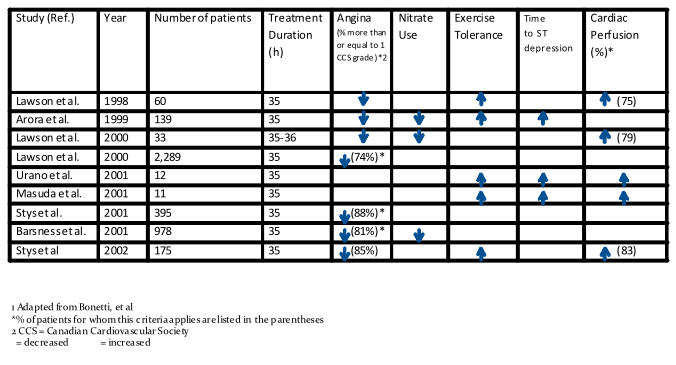
Summary table: Published Controlled and Uncontrolled Trials of EECP in Patients with Stable Angina
EECP lowers systolic blood pressure
A recent study looking at 108 patients undergoing EECP showed systolic blood pressure reduces significantly following EECP treatment.
Stratified differences were sustained after individual EECP sessions, at the end of the course of EECP, and 6 weeks after the final EECP session and were independent of changes in cardiovascular medications. The reduction in systolic blood pressure is likely to contribute to the beneficial outcomes seen with EECP.
Am Heart J. 2008 Dec;156(6):1217-22.