
















These changes can be summarised as follows:
1. Diastolic augmentation -> increased coronary perfusion
2. Systolic unloading -> reduced cardiac workload and increased cardiac output
Mechanism of Action - OVERVIEW
What is angina and how does EECP help?
Angina symptoms occur when the heart’s need for oxygen and nutrients in blood are greater than the coronary artery blood supply can achieve. This usually causes chest pain (angina symptoms), and often initially occurs on exercise when the heart’s workload increases but areas of narrowing with atherosclerosis and fatty deposits as seen in the diagram below limits the blood supply to the heart muscle.
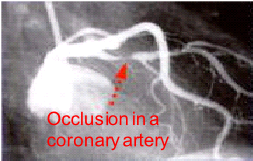
Despite maximal medication and surgical treatment some patients continue to experience angina symptoms during minimal or moderate exercise or even at rest. This is termed “refractory angina”. In this situation EECP may be the only way of achieving symptom relief and a better quality of life, as further surgery may not be possible or provide too high a risk of serious complication.
The Effect of EECP on circulation
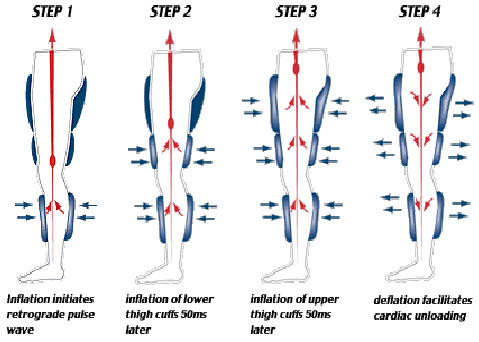
The diagram shows the three blood pressure cuffs (blue areas) around the leg and buttock area. The artery (red line) normally carries blood in the direction of the groin down to the foot.
Steps 1 – 3 (during the heart relaxation or “diastolic phase”)
Steps 1 to 3 show the rapid succession of contraction of the cuffs, squeezing first the calf, thigh then upper thigh cuffs in sequence, causing the reverse “counter-pulsation” of freshly oxygenated blood back up to heart and coronary arteries during the heart’s rest phase (diastole). Simultaneously, this increases the volume of blood in the veins returning back to the heart under pressure of the cuffs.
Step 4 (during heart contraction or “systolic phase”)
Just before the next heart beat the cuffs simultaneously deflate, significantly reducing the work load of the hearts next contraction as the vascular beds are relatively empty when the cuffs are deflated. This significantly lowers the resistance to blood ejected by the heart. This reduces the amount of work the heart must do to pump oxygenated blood around the body.
Collateral blood vessel formation and increased myocardial perfusion
EECP does not unblock the “furred” arteries, but it is thought EECP may enhance or stimulate the opening of collateral channels in the coronary vascular system, increasing perfusion of ischaemic areas, which may form bridges for blood supply around the narrowed arteries. While the exact stimuli and mechanisms for the development of coronary collaterals in humans is unknown, studies have shown that when diastolic pressures were raised above systolic pressures, sequential external counter pulsation was effective in increasing myocardial perfusion and promoted the formation of collateral circulation. Studies have demonstrated both initial and sustained (3-year) improvement in myocardial perfusion of ischaemic areas as demonstrated through thallium-201 imaging,
Neuro-hormonal changes on blood tests
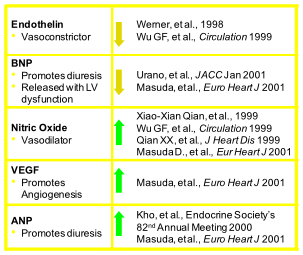
Studies have associated EECP with numerous measurable chemical changes such as an increased release of the body’s vaso-dilator nitric oxide, increased VEGF which is a growth factor associated with new blood vessel formation, and decrease in endothelin which constricts blood vessels.
Changes on the blood vessel endothelial lining
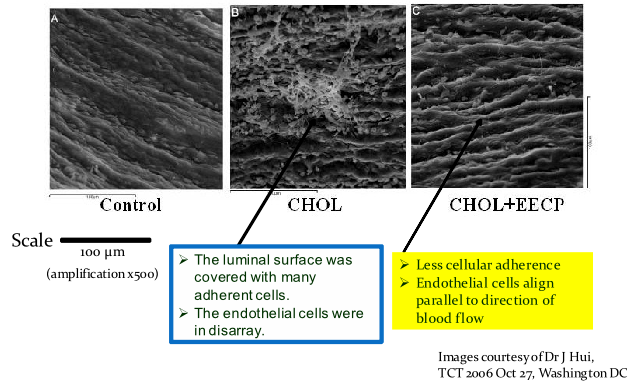
Further research using powerful microscopes shows a structural change in the blood vessel lining (the endothelium) similar to changes seen from vigorous exercise which may also be responsible for an improvement in physiological blood vessel dilation, function and circulation.
Watch the How EECP works Video
- Collateral blood vessel formation
- Retrograde aortic pressure wave
- Increased myocardial perfusion
- Increased endothelial function and vasodilation: ↑ nitric oxide,↓ decreased endothelin-1, ↓ BNP
- Increased venous return
- Decreased systemic vascular resistance
- Increased cardiac output
- Decreased myocardial oxygen consumption and workload
How does EECP have sustained benefit for angina?
Collateral blood vessel formation and increased myocardial perfusion