
















EECP - Information for Doctors
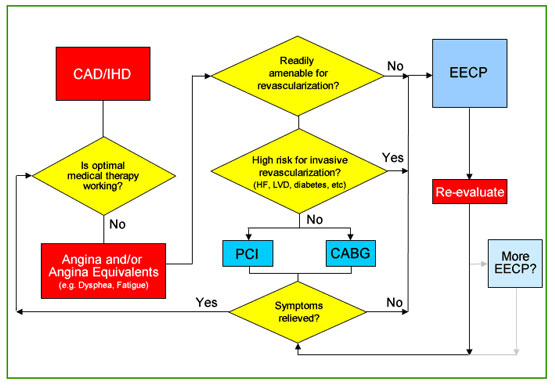
Patients who may benefit from EECP include:
Patients who may benefit from EECP include:
1. Patients with angina or angina equivalent symptoms who:
- No longer respond to optimum medical therapy
- Restrict activities to avoid symptoms
- Are unwilling to undergo additional invasive revascularization procedures
- Have LV dysfunction (EF<40%), ischaemic cardiomyopathy
2. Have co-morbid conditions that increase the risk of revascularization procedures
- diabetes
- heart failure
- pulmonary disease
- renal dysfunction
3. Elderly patients at high risk for morbidity/mortality from PCI/CABG
Contraindications Top
The clinic and consultant cardiologist will review contraindications and suitability for EECP
- Arrhythmias that interfere with machine triggering (need rate controlling)
- Bleeding diathesis (INR <2.5)
- Active thrombophlebitis
- Severe lower extremity peripheral vascular disease
- Presence of a documented aortic aneurysm requiring surgical repair
- Pregnancy
The clinic and consultant cardiologist will review these factors prior to EECP
- Patients with blood pressure higher than 180/110 mmHg should be controlled prior to treatment
- Patients with a heart rate of more than 120 bpm should be controlled prior to treatment
- Patients at high risk of complications from increased venous return should be carefully chosen. Decreasing cardiac afterload by optimizing diastolic augmentation may help minimize increased cardiac filling pressures due to increased venous return.
- Patients with clinically significant valvular disease should be carefully chosen and monitored during treatment with enhanced external counterpulsation. Certain valve conditions, such as significant aortic insufficiency or severe mitral or aortic stenosis, may prevent the patient from obtaining benefit from diastolic augmentation and reduced cardiac afterload in the presence of increased venous return.
Is EECP cost-effective? Top
To provide a reference point for cost-effectiveness, the National Institute for Health and Clinical Excellence (NICE) uses a threshold cost per QALY (quality adjusted life years) as a marker for the length and quality of life that is increased per pound spent of around £20,000-£30,000 to determine whether an intervention represents good value for money in the NHS.
A draft publication of the cost effect of EECP has recently been produced, following commission from the HTA which forms part of the assessment process used by NICE. The base cost effectiveness analysis of EECP falls below the above cost threshold, making EECP a cost effective treatment.
This is summarised in the HTA report, “Based on current evidence, EECP appears cost-effective for this patient population (angina patients as in MUST-EECP trial), but there is significant value to future research informing the long-term maintenance of quality of life benefits from EECP. “
At this time there is a significant body of evidence showing long term reduction in the severity of angina symptoms using functional scores such as the Canadian Classification (see CCS section) over several years. Specific data using quality of life questionnaires has only been gathered up to one year after EECP.
Longer term quality of life data has been recorded by NHS units in the UK which is demonstrating a lasting improvement in quality of life scores and a significant reduction in cardiac admissions post EECP.
A baseline analysis of the cost effectiveness of EECP therefore was determined by HTA to be £18,600 per additional QALY gained, which is certainly cost effective based on NICE criteria.
This is also based on just 12 patients being treated per bed per year, and given greater use of EECP the efficiency will increase and cost of the EECP treatment will reduce, further increasing the cost effect of treatment.
The cost effect is also anticipated to further improve as evidence is gathered directly supporting that EECP benefit to quality of life is sustained over longer periods of time, with a projected cost of just £5,831 per QALY as an incredibly cost effective best case scenario. Indirect measures of improved quality of life already support this favourable cost effectiveness and the specific long-term quality of life data now needs to be gathered.
Studies from the USA, where EECP is much more widely utilised and funded via Medicare, support high level of cost effectiveness with a reported cost of just $3126 US dollars per QALY (quality adjusted life year) gained following EECP treament.
In comparison to this, the benefit of various drug-eluting cardiac stents have recently been assessed by NICE which showed the cost for various stent insertion procedures to be on average £120,000 - 180,000 per incremental QALY gained. (click here to link to full NICE guidance on drug eluting stents).
How to refer? Top
We accept referrals from:
GP’s, Cardiologists, and patient self–referrals and perform EECP for PCT and privately funded patients.
We will arrange a free pre-assessment.
Referrals & enquiries to:
The Dove Clinic for Integrated Medicine
The Old Brewery
High Street
Twyford
Winchester
Hants, SO21 1RG
Tel: 01962 717060
Email: secretaries@doveclinic.com
For further information regarding EECP, to arrange further discussion or for clinical enquiries please contact Dr Richard Fuller at The Dove Clinic.